
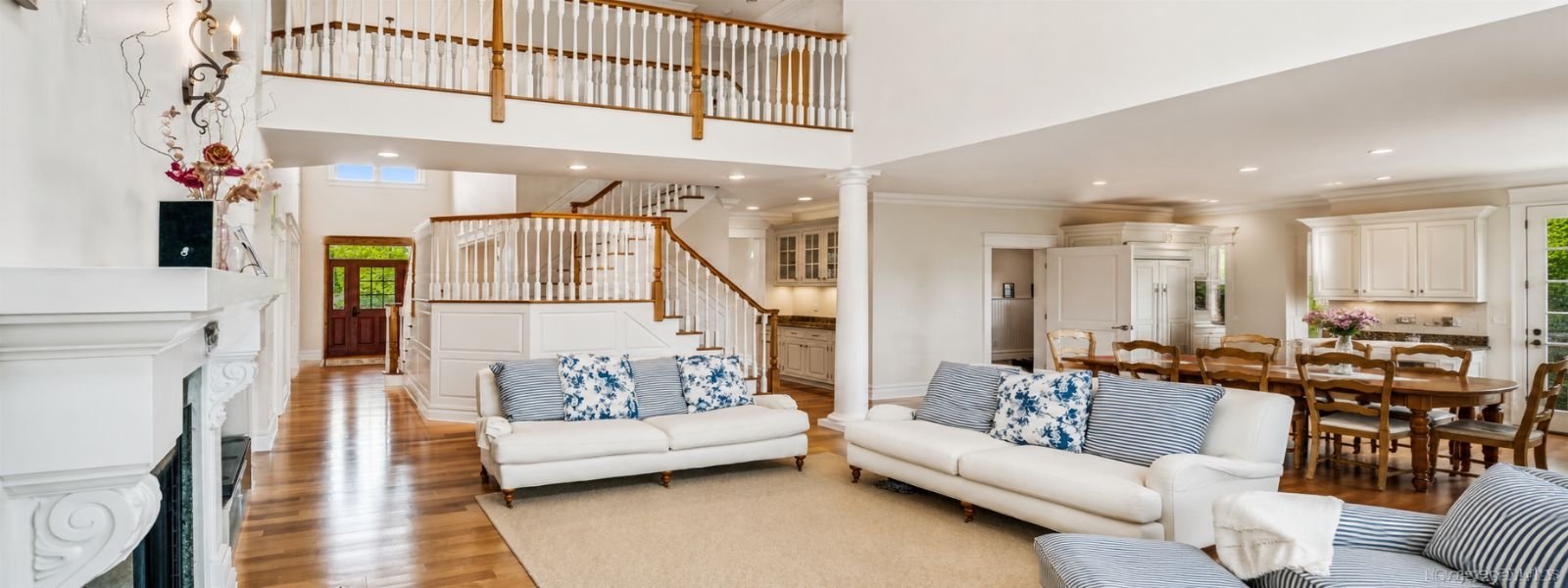
Why Some Beautiful Rooms Don’t Photograph Well
I’ve walked into rooms that look fantastic in person and then become surprisingly difficult to photograph.
Standing in the room, you can take in everything at once. The light, the materials, the furniture, the ceiling height, the view and the way the space connects to everything around it all contribute to the experience. A camera doesn’t get that luxury. It has to reduce all of that information to one frame from one position.
That is where a beautiful room can become a difficult photograph.
I don’t think the problem is necessarily the room. Sometimes the room simply needs to be photographed differently than it feels when you’re standing inside it. The things that make a space enjoyable in person aren’t always the same things that make a strong two-dimensional image.
A Room Has Depth. A Photograph Has a Frame.
When you’re physically standing in a room, you can move your eyes around. You can look toward the windows, then notice the fireplace, then turn toward the kitchen. Your brain is constantly assembling all of those pieces into one understanding of the space.
A photograph has to make those decisions for you.
The frame has edges. Everything inside those edges competes for attention, while everything outside them disappears completely. That means a room with a lot of beautiful elements can actually be harder to photograph because there are too many things competing to become the subject.
This is one reason I don’t think the answer is simply to use a wider lens.
A wider lens can fit more into the frame, but it doesn’t necessarily make the photograph easier to understand. Sometimes it just gives the viewer more information to sort through.
The Best Part of the Room May Not Be Obvious From the Doorway
There’s a natural tendency to photograph a room from the first position that seems to show the most.
That can be a mistake.
The doorway may give you a clear view of the entire room, but perhaps the strongest composition is from another corner. Maybe the relationship between the fireplace and the windows becomes much more interesting from the side. Maybe the kitchen looks better when the camera moves slightly into the adjoining room.
This is why I want to look around before I start taking photographs.
I’m trying to figure out what the room is actually doing visually. Where does the eye naturally go? What is the strongest feature? What relationships between objects or spaces are worth showing?
Sometimes the answer is not where you initially expect it to be.
Furniture Can Look Very Different Through a Lens
Furniture is another reason a room can photograph differently than it feels in person.
When you’re standing inside a room, your brain understands that a sofa is a sofa and a chair is a chair. You naturally compensate for their position and scale because you’re experiencing the entire space.
The camera doesn’t compensate.
A chair near the edge of a wide-angle frame can suddenly look much larger than it feels in the room. A coffee table can become visually dominant. A sofa can block a sightline that seemed completely open when you were standing there.
This is where perspective becomes important.
Moving the camera even a few feet can change those relationships dramatically. The furniture hasn’t moved, but the photograph can suddenly feel more balanced.
Beautiful Light Can Still Be Difficult Light
Good light doesn’t automatically mean easy light.
A room can have gorgeous windows and beautiful natural light, but if the contrast between the interior and exterior is extreme, creating a balanced photograph becomes more complicated. Bright windows, darker interiors and reflective surfaces all have to coexist in the same frame.
There is also the question of what the light is doing to the room itself.
Maybe the sunlight creates beautiful shadows across the floor. Maybe it highlights a particular material. Maybe it creates glare on a surface that looks perfect in person but becomes distracting in a photograph.
I’m not trying to eliminate every shadow or make every part of the room equally bright. I’m trying to understand what the light is contributing and how the photograph can use it rather than fight it.
Some Rooms Need Less in the Frame
This is probably one of the hardest things to accept when you’re trying to show a beautiful property.
Sometimes the strongest photograph comes from leaving something out.
If a room has a great fireplace, beautiful windows and interesting cabinetry, it can be tempting to find a position that includes all three. But if fitting everything into the frame makes each element smaller and less important, the photograph may actually become weaker.
I would rather make a clear decision about what the photograph is trying to communicate.
Maybe one photograph establishes the room. Another focuses on the architecture. A third shows the relationship to the adjoining space.
The property doesn’t need to be compressed into one photograph just because the room contains a lot worth seeing.
Photographing a Beautiful Room Is Still an Exercise in Editing
I think this is the part that gets overlooked.
Photography is often described as capturing what is there. In reality, a lot of the work involves deciding what not to capture.
The camera gives me an enormous amount of information, but the photograph needs a point of view. I have to decide where to stand, what belongs in the frame, how much of the room to show and what should receive the viewer’s attention.
That becomes even more important when the room is beautiful.
An ordinary room may have only one obvious feature to emphasize. A beautiful room can have five.
The challenge is deciding which one matters most in each photograph.
Sometimes the Room Is Better Than the Photograph
I actually think that’s an important distinction.
A photograph doesn’t have to prove that the room is beautiful. It has to communicate enough of what makes the room worth seeing that the viewer wants to experience it for themselves.
That means I don’t want to force a room into a photograph that doesn’t suit it.
If the room feels expansive in person, I want the perspective to communicate that without creating distortion. If the architecture is the reason the room is interesting, I want the composition to give that architecture some attention. If the natural light is what makes the space special, I want the photograph to preserve that quality.
The job isn’t to make the camera reproduce the experience perfectly. That’s impossible.
The job is to make smart decisions about which parts of that experience can be communicated through a photograph.
And sometimes, that means recognizing that the most beautiful room in the house may require the most thought before I press the shutter.
FAQs
Why do some beautiful rooms photograph badly?
A room can look great in person but become visually complicated inside a two-dimensional frame. Perspective, furniture placement, lighting and too many competing elements can all affect the photograph.
Does a beautiful room automatically make a good photograph?
No. A strong photograph still requires decisions about camera position, composition, perspective and light.
Why doesn’t using a wider lens always solve the problem?
A wider lens can show more of the room, but it can also introduce distortion and make the composition more difficult to understand.
Why does camera position matter in a difficult room?
Moving the camera changes the relationships between furniture, architecture, windows and other elements. A small adjustment can create a much cleaner composition.
Can furniture make a beautiful room difficult to photograph?
Yes. Furniture can block sightlines, dominate the frame or appear disproportionately large depending on the camera position and lens.
Can too much natural light make a room difficult to photograph?
Yes. Strong contrast between bright windows and darker interiors can make it challenging to create a balanced image while maintaining a natural appearance.
Should every beautiful feature of a room appear in one photograph?
Not necessarily. Several strong photographs can communicate a room more effectively than forcing every feature into one frame.
What should a photographer look for before photographing a difficult room?
I would look at the strongest architectural features, available light, furniture relationships, sightlines and how the room connects to surrounding spaces.
Is editing enough to fix a poorly composed photograph?
Editing can improve many aspects of an image, but it cannot completely replace decisions about perspective, camera position and composition made before the photograph is taken.
How can professional real estate photography help difficult rooms?
A thoughtful photographer can evaluate the room before shooting and make deliberate choices about perspective, composition, lighting and what deserves attention.
The room hasn’t failed the photograph
Sometimes I think we put too much pressure on the property to make the photograph work.
If a room is beautiful in person but difficult to photograph, that doesn’t necessarily mean something is wrong with the room. It may simply mean the camera needs a little more help understanding what makes the space special.
That’s where the thinking starts.
Before I take the photograph, I want to understand what I’m actually looking at. Once I know what makes the room interesting, I can start figuring out how much of it needs to be in the frame, where the camera belongs and what the viewer should notice.
If you’re preparing a property for market on Long Island and have a space that looks better in person than it seems to photograph, that’s exactly the kind of challenge I enjoy working through.